 By Lauren Dickey, Customer Engagement
The assertion that media measurement is at an inflection point has become so cliche that it has effectively become a platitude. More digital ink than is useful has been spilled over the analysis of our collective problems as media professionals, so let’s be brief: The signals that decision makers rely on to inform billions of dollars of media inventory are getting weaker and noisier. TV’s incumbent currency provider lost its accreditation, and after more than a year, still isn’t ready to demonstrate improvements. Industry discontent with their hegemony is so ubiquitous that the major (and minor) players are all but engaged in open revolt, racing to find alternative currencies. Walled gardens capture the lion’s share of consumer data, and marketing budgets have followed despite the inability to accurately measure these sources, or to understand their performance in the context of global campaign efforts. The third party cookies which marketers historically have relied on to understand online behaviors are going the way of the dodo bird, thanks to a combination of increasing consumer awareness of information privacy and a concurrent uptick in government regulation. Given the impending doom of recent economic forecasts, marketers, more than ever, need a comprehensive understanding of how their campaigns perform across channels to maximize the impact of every ad dollar spent.
As an industry, we’re all well aware of the challenges. Let’s talk solutions.
As tech evolves, society evolves. And as society evolves, media consumption evolves. The way we measure media consumption ought to evolve too. At this point it should be fairly uncontroversial to assert that the digital data free-for-all of the pre-COVID era wasn’t particularly effective at enabling measurement. Indeed, the incumbent lost its accreditation, in part, for concluding that consumers watched LESS television during Covid. Yeah, right. Marketers still complained about separating signal from noise, (and good luck with cross platform reach and frequency) so it would be foolish to continue using that model as a framework moving forward.
Lucky for us, a certain industry group known as the WFA (World Federation of Advertisers) took on the heavy lift of thought leadership around what the future of measurement should look like, and in 2020 released a proposed framework. The first item on the docket?
A Single Source Panel (or multiple separate panels) acts as the arbiter of truth, providing benchmarks for the use and overlap of media consumption across channels and screens, in addition to census data collected directly by Data Participants.
Hypha’s panel delivers exactly this solution. Our privacy-friendly, opt-in Centric Origin Data™ includes validated demographic and economic data, and derives all behavioral inputs from a single source in real-time. This delivers a comprehensive view of what media individuals consume across platforms and devices. Hypha reports each and every instance of an individual consumer’s exposure to content, advertisements, brands, and products as a distinct cluster of data. As such, Hypha definitively provides the exact occurrence of individual media experiences, which appear in our data product as session-level consumption events.
Analysis of Hypha’s existing sample of households exposes unexpected viewing behaviors. At scale, Hypha will be a single source of data to use as a benchmark for identifying outliers across census-level data. In other words, Hypha data will help remove noise from signal.
Now, let’s talk about why respecting information privacy and adopting a privacy-friendly framework for the future of media measurement is imperative.
Consent, and by extension, privacy, is critical when hyper-granular data is collected, because “from the prosaic, the sensitive can be inferred”. This point is precisely and expertly made by Danielle Citron in her recent IAPP interview where she explains her thesis on “intimate privacy”. Informed consent and information privacy are critical considerations as we develop the next generation of media measurement solutions, because content consumption data with added demographic and geographic context can reveal an eerily deep understanding of individual behaviors and identity. If there is any doubt about the general level of popular sentience on this issue, I invite you to check out this Family Guy episode (Season 21, “Bend or Blockbuster”).
Neil Richards is a law professor at Washington University School of Law. He recently released a book titled Why Privacy Matters. I strongly recommend my media compatriots check it out, because he offers a straightforward explanation on why we should care about privacy in media measurement. He posits the following:
- The flow of human information has become one of the most important building blocks fueling the Information Age, analogous to the oil that fueled the Industrial Age
- If we think about “privacy” as the rules that govern human information (data), a battle is being waged over the “new oil” and how it is collected and used
- Information is power, and human information confers power over human beings. The rationale for collecting information is to influence human behavior.
- Privacy isn’t dead, but it is up for grabs. The rules and social norms we develop around the collection of human data will significantly impact what it means to be a human, citizen, and consumer in our post-industrial information society.
HyphaMetrics’ Centric Origin Data™ data is generated from fully informed and fully consented, opted-in panelists. Panelists must physically install Hypha hardware in their homes and register their connected devices, so there is no ambiguity around what is being collected and why (i.e., “fully informed”). As privacy rules and regulations are proposed and implemented with increasing velocity, and fines for violations become increasingly impactful, Hypha offers a data solution that customers can rest assured is privacy compliant.
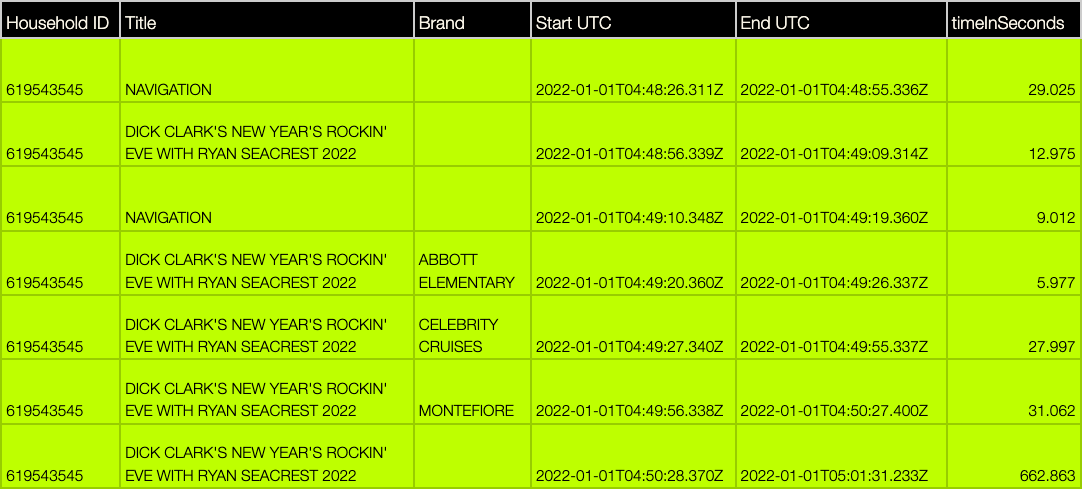
Here at Hypha, we believe talk is cheap, so we follow an ethos of “Don’t tell me, show me.” Illustrations of Hypha data outputs are below. The objective is to show the level of granularity Hypha reports, while also inspiring consideration of what this data could mean at scale in becoming a viable, privacy-friendly solution for the media industry. For presentation purposes in this article we’ve condensed the output to only contain TV viewing activity, but our data also includes secondary device and presence detection (i.e., who is watching) data as well.
The following example is viewing behavior that occurred on New Year’s Eve 2022, and illustrates Hypha’s ability to capture broadcast TV viewing behavior. While there are other TV data vendors who offer broadcast TV consumption data, they are not reporting presence of, or time spent in a navigation panel:
We’ll up the proverbial ante in this next example, illustrating how Hypha is able to capture non-broadcast content. Hypha uses a combination of machine learning and computer vision to detect any activity that occurs on the TV screen, regardless of the source. This is a distinct differentiator from ACR data solutions, which rely on a library of ingested content to report detections:
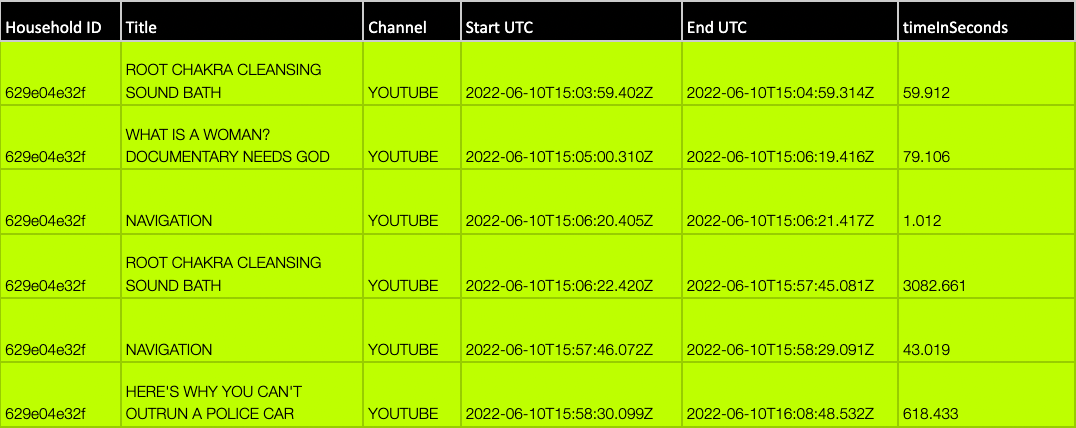
As we can see, Hypha outputs contain unparallelled granularity that isn’t available anywhere else in the market.
As an “Elder Millennial” I came of age in the golden era of social media and was perfectly comfortable broadcasting my entire life online. I had no concern about what information I was distributing to the world. An early evangelist of data targeting (circa 2009), I was fortunate to join BlueKai in 2013. I was dismissive of non-industry folk’s privacy concerns, firing back something along the lines of, “You really aren’t that interesting, and [Enter Brand Name Here] really only cares about delivering a message to get you to buy their stuff.”
I remember walking to work in San Francisco on November 9, 2016, the fog even thicker from the post-election hangover. The atmosphere was eerily reminiscent of the day after September 11. People on the street were subdued, shaken, in disbelief. The aftershock came in 2018, when Christopher Wylie revealed what was going on at Cambridge Analytica, and I learned a hard lesson about the law of unintended consequences that left me seriously rethinking my own small but complicit role in the surveillance economy. If that wasn’t enough, the recent Dobbs decision only served to cement my own personal and ethical concerns about gratuitous data collection and reselling. If you care about decisional privacy (and by extension, bodily autonomy), you should be concerned about information privacy too.
Now, taking this full circle, I started off with platitudes, so will end with platitudes: The most effective way to change a system is from within.
As a digital-first native, if someone told me ten years ago that I would be strongly advocating for a next-gen panel as a solution to the media industry’s measurement woes, I would have spit out my pinot (Williams-Selyem, for those who know). I basically grew up in the Church of Big Data and never considered anything but the innocuous application of serving targeted ads. But alas, we serve ads to influence human behavior, and the implications of our success reach far beyond driving commercial activity.