The first and only Artificial Intelligence and Machine Learning based measurement system
that captures media the way viewers see it
Turning on the TV today presents an influx of different viewing options– whether that be the content itself, the device through which your content is accessed, or the platform or network that delivers that content to your screen. Choice is inherent in today’s viewing environment. And that’s a good thing.
As media technology providers, it is our responsibility to understand that viewing behavior in its entirety. Our data– that granular understanding of how consumers are behaving with media– fuels decision making that ultimately determines how much the advertisements supporting that content should cost, whether that show you’re watching gets greenlit for a new season, or even if that free streaming platform you are watching on remains free. That’s why it’s imperative that we, as an industry, get it right.
“Different buyers may have different KPIs, but all advertisers require consistency in their measurement approach across channels, regardless of the measurement provider”, said Cara Lewis , chief investment officer at dentsu at last month’s One23 conference. As we collectively strive toward interoperability, consistent and accurate measurement of consumer media experiences is the fulcrum of its success.
Hypha’s Unified Neuromedia Identification Engine (UNIe) uses Artificial Intelligence, Machine Learning, and Computer Vision to ensure precise measurement of exactly what occurs on viewers’ TV screens. The result is 100% accurate TV omnichannel data, inclusive of content, advertising, product placement, and brand sponsorship – achieving the exact consistency that is being requested by decision-makers to reintroduce confidence in their investment strategies.
In today’s fragmented viewing environment, UNIe produces a unified understanding of everything that happens on the TV screen, positioning it as the best available technology to capture modern media behaviors and the only solution to finally solve measurements’ zero-cell problem.
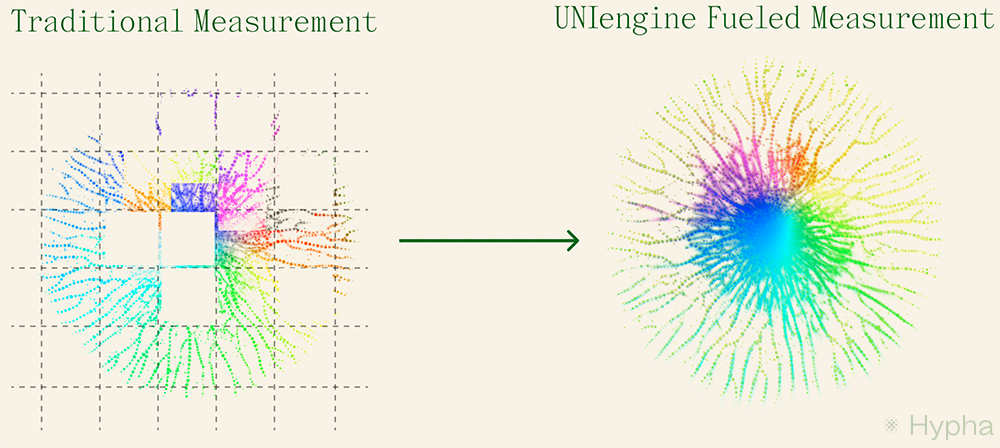
Why do Zero Cells Exist in the First Place?
Today’s measurement structures have become over-reliant on ACR technology to infer what is occurring on the TV screen. ACR technology captures an audio or visual snippet from the TV and then matches that snippet back to a reference library to decide what was playing. This “match back” approach presents a number of hurdles for accurate measurement.
The reference library against which the detected snippet is matched must be comprehensive enough to cover the full spectrum of content and advertising available to modern consumers. As this is always changing, keeping these reference libraries refreshed and up to date is costly and cumbersome to maintain and means that an exact match cannot always be made.
ACR data cannot definitively capture the entirety of the TV omnichannel experience due to its reliance on schedule data to determine what and how it was watched (what network, what time, etc.). When content was viewed only in a scheduled environment (meaning, when people watched it when it aired on live broadcast), this lent itself to more accurate data. But as new viewing options have become available, we as a society have adopted more time-shifted viewing behaviors (streaming, DVR, VOD) and so TV schedules have become a decreasingly accurate resource for measurement methodologies.
Using measurement technology that was developed in a less complex media environment to capture today’s complex on-screen experience leaves entire realms of behavior (such as time-shifted viewing) unaccounted for. A dynamic viewing environment requires commensurate technology. In our ever-changing viewing paradigm, a reliance on ACR technology results in incomplete data.
It’s time for a new approach.
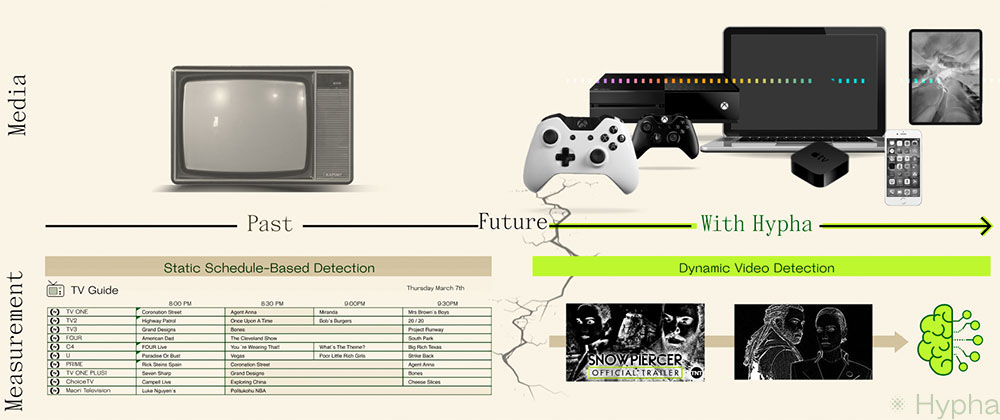
A Comprehensive Approach to Finally Fill in the Blanks
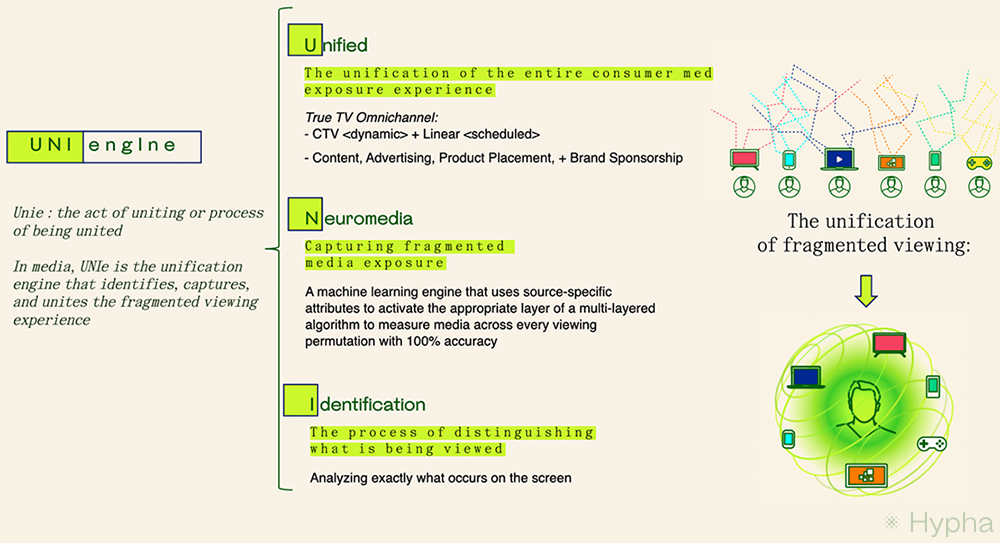
Hypha’s UNIe captures exactly what is happening on the screen as it happens, and analyzes it using a source-specific algorithm to ensure that we understand not only what is appearing on the screen, but how the content, advertisements, product placement, and brand recognition made its way to the screen in the first place providing a complete understanding. This includes every platform, device, and walled-garden consumer allowing us to finally break down silos.
Each layer in the UNIengine™ consists of algorithms that passively measure the entire user journey of selecting content (source, platform, program, and content) and the consequent viewing that occurs upon analyzing the captured information and reporting exactly what occurred on the screen. The system works passively to granularly measure every media nuance available allowing for the true unification of linear and digital (including CTV). The output is highly granular data inclusive of content, advertising, product placement, and brand sponsorship that unifies the entire TV omnichannel experience.
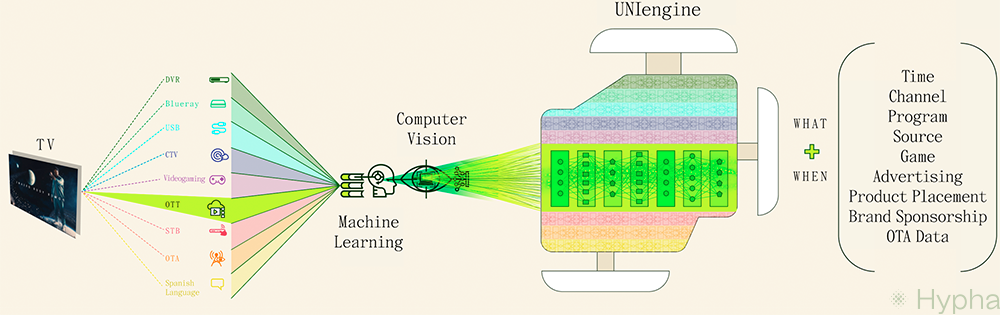
As new advertising formats become available (such as NBCU’s recent integration of dynamic product placement), in addition to new content formats that must be understood (such as the difference between
produced content and user generated content) , UNIe is the only flexible measurement technology capable of keeping pace with changing viewing behaviors.
A Matchkey to Activate Interoperability
Data derived from the UNIengine provides the necessary matchkey to link together data sets from across the media landscape. A matchkey is a source of truth that calibrates and connects other large datasets. It serves as a golden record to join disparate data sources and create a holistic behavioral reflection.
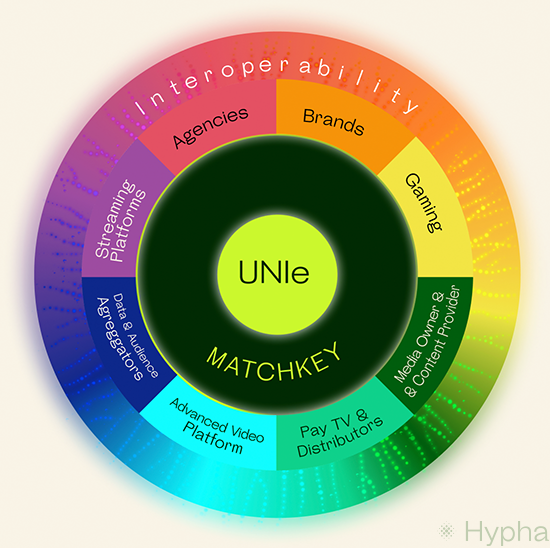 The current media infrastructure keeps data locked up behind walled gardens. While, for example, a Smart TV provider might know what is being viewed on their particular brand of TVs, they do not know what is happening on other Smart TV brands, or on STB devices, OTA, or OTT devices. But with UNIe data as a matchkey, that Smart TV provider can understand all content, advertising, product placement, and brand sponsorship that occurs on their TVs, other Smart TVs, STB devices, OTT devices, gaming devices, and so on. The unprecedented level of granularity afforded by UNIe data connects data sources that have never been able to communicate.
In order for an interoperable future to truly occur, a matchkey that is built on a golden record of unified media behaviors must be integrated, providing clean data on cross-platform experiences. Hypha’s UNIengine provides the necessary matchkey to join disparate data sources and create a holistic reflection of true media behaviors.This level of granularity is only possible through a complete, flexible, and passive measurement. With UNIe as the matchkey, stakeholders across the media ecosystem can finally speak the same language and work together interoperably.
Moving into the Future
Capturing changing viewing behaviors requires technology that can continue to adapt with society as behaviors change. The continued use of ACR technology pigeon-holes measurement to network TV schedules and content libraries that are not always accurate and are costly to maintain. This approach neither reflects how consumers behave today, nor can it change with society as behaviors change.
The UNIengine was built to be adaptive. Flexible technology continuously optimizes for the present and future to change at the rate of culture. We understand that while today’s behaviors may be heavily influenced by streaming, gaming, app-based viewing, the future will always deliver viewing behaviors that we never could have anticipated. As such, our agile technology will always adapt to how we as a society are behaving.
The integration of data sourced from the UNIengine provides the necessary matchkey to unlock an interoperable media future. The adoption of a common language delivered by a holistic source of truth will ultimately result in restored accuracy across the media landscape, empowering stakeholders to streamline decision making, allocate budgets more effectively, and ultimately facilitate better experiences for consumers.