The media landscape is changing before our eyes. Consumers have more choices than ever before spread out over content, ads, devices, and platforms. But the measurement paradigm that forms the foundation for this ecosystem is at an impasse: the solutions that had informed key decision making for decades are no longer applicable, available, or adequate.
Changing dynamics require an examination of such change. Tom Smith, a renowned researcher at NORC’s Center for the Study of Politics and Society laid out the Laws of Studying Societal Change:
- First Law: The way to measure change is not to change the measure.
- Second Law: When constant measures produce non-constant measurement, change the measure to measure change.
As such, an examination of this change must occur in order to introduce new approaches to measurement. Three key components inform this changing media landscape: the death of the 3rd party cookie, the proliferation of walled gardens across the media ecosystem, and the emergence of new trading currencies. Each of these three forces presents unique challenges to the existing paradigm, and together create a complex new paradigm that must be addressed.

Death of the Cookie
For the past decade, cookies have played an integral role in digital ad targeting. Cookies carry information on the identity of the individual’s browsing behavior across different sites, allowing advertisements to be served to the individual based on the tracking and logging of their information. But as data privacy has grown increasingly concerning for consumers, demands for more control over user data are being met by the major players in the space.
Apple began rolling out restrictions on the use of cookies on their browser Safari in 2017, followed by Google announcing its plan to fully phase out all third-party cookies in 2020. Google will phase out the use of cookies in the second half of 2024. The deterioration of personalization has been predicted to cost digital media companies between $32 billion to $39 billion by 2025, according to John Deighton, a professor at Harvard Business School. As such, new data approaches are needed to provide this crucial user data in a privacy compliant manner.
Proliferation of Walled Gardens
Walled gardens are closed media platforms where the owner has total control over what happens within its walls– such as Samsung, Meta, Google, or Netflix. The platform handles all the buying, serving, tracking, and reporting. Walled gardens use their own first-party data to deliver results for advertisers, but advertisers can’t take that data – even if it is generated by their own users – to other platforms. This means that advertisers can neither see into the greater happenings of each walled garden environment nor export information out of it, ultimately inhibiting their ability to understand how time is spent across all the various platforms consumers have access to. Without this insight, it is impossible for advertisers to allocate media budgets in alignment with true consumer behavior.
This dynamic has serious consequences across the media landscape. Closed platforms make up a disproportionate amount of global ad spend and have more user data than anyone else, gobbling up market share that used to go to television broadcasters, local newspapers, and the open web. This results in a disproportionately valued marketplace where publishers creating content outside walled gardens are not receiving ad dollars commensurate with time spent on their platforms and marketers are unable to reach campaign objectives without an understanding of behavior across the entire consumer experience.
This lack of transparency across platforms impairs the market’s ability to appropriately value content, advertising, and consumer engagement and results in subpar media experiences for consumers whose preferences are unable to translate from one platform to the next.
The walls separating these platforms are only growing higher. While Americans spend about 66% of their time on the open web, those sites only receive about 40% of digital ad budgets[1]. In the past four years, ad spend on walled gardens has grown from 63.1% of global digital ad revenue to 75.3%. It is predicted that by 2025, this number will grow to 80.8%. In the CTV space, Roku captures 39% market share of CTV devices in the United States, with Amazon close behind at 30%[2]. More than 40% of consumers now subscribe to over three streaming services, and despite the fragmented behavior, over half wish that their preferences would carry over from one service to another[3].
Multi-Currency Trading
For decades, the media industry relied on a single trading currency to determine the value of ad space on television. This single currency ensured that media was measured accurately and advertising was sold at fair market value. But in recent years, as consumer behavior has evolved and splintered across a wide array of different platforms, the number of data points that need to be collected to inform this currency has grown exponentially.
With this fracturing, the use of a single currency has ceased to reflect the vast and fragmented landscape of consumer viewing behavior. This lack of standard measurement across these disparate sources has created inconsistencies and blindspots in how to allocate media, so the industry’s most powerful companies are leading the search for alternatives.
From NBCU integrating data from iSpot for national upfront ad buys, to Paramount using VideoAmp, and WarnerMedia selecting iSpot, Comscore, and Videoamp as new currency providers, the industry is shifting from a monopolistic ecosystem into an open marketplace.
In order for this new approach to trading to manifest fully, measurement providers will need to work together interoperably to reflect the true consumer experience. This requires a source of truth to benchmark all data inputs against, collected through a panel. And while these emerging currency providers have massive data sets, they rely on weighting to reflect the entire US and correct bias in their data. This requires calibration by a truly nationally reflective dataset in order to reflect all types of homes that exist across the country.
The industry has taken note of this, as we see leaders put more energy into panels: in the past month, announcements have been made by the ANA and VAB, as well as Google on the creation of panels for data calibration purposes. The increasing relevance of panels demonstrates the vital role they play across the media ecosystem.
So What?
Each of these three layers contributes its own unique challenges to tomorrow’s media infrastructure. And together, they create a complex new paradigm that drives an already fragmented media landscape to new edges. An industry that was once made up of a simple transactional chain has become convoluted without a common trading language among key industry stakeholders. While there used to be one buying path of ads to a single piece of content on TV (i.e. buying an ad for a nationally broadcast show on a network through their network sales team), buying options have become greater in quantity and disbursement. Advertisers no longer have a centralized location to understand the individual value of all their media options. Without this common understanding, decision makers operate blindly in their ability to reach the right audience with the right message in the right place at the right time.
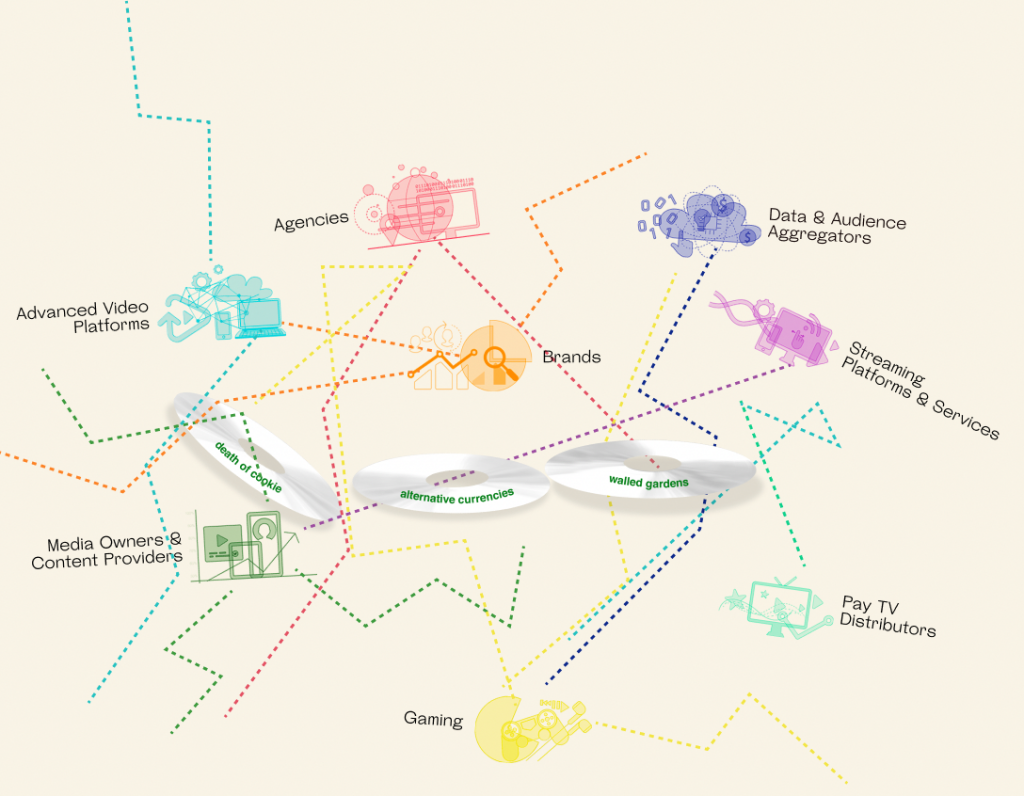
The Linchpin of Interoperability
The missing component across the board is a common understanding of how people are actually spending time with media across all the various permutations that exist today. Hypha’s proprietary panel of opt-in consumers merges cutting edge technology with industry-expected best practices for media research allowing us to measure every single touchpoint in the modern media environment in a privacy compliant manner. The output, known as Centric Origin Data, represents the holistic individual media experience— all behavioral touchpoints in connection with one another.
While other measurement approaches require the aggregation of multiple disparate data sources in order to stitch together an assumption of what an experience might be, Centric Origin Data derives all these individual behavioral inputs from a single source in real-time
Our Centric Origin Data is a subset of Zero Party Data, meaning that is obtained through an entirely permissioned, opt-in manner. This future-proofs our data collection methodology against the rise in privacy regulations and makes our data a perfect solution to replenish data pipelines. Centric Origin Data sees across all walled gardens providing never before available insights into the holistic media experience. Hypha’s ability to provide a unified individual media metric fuels our new multi-currency reality by facilitating the connection, communication, and collaboration necessary to elevate trading practices across the industry.
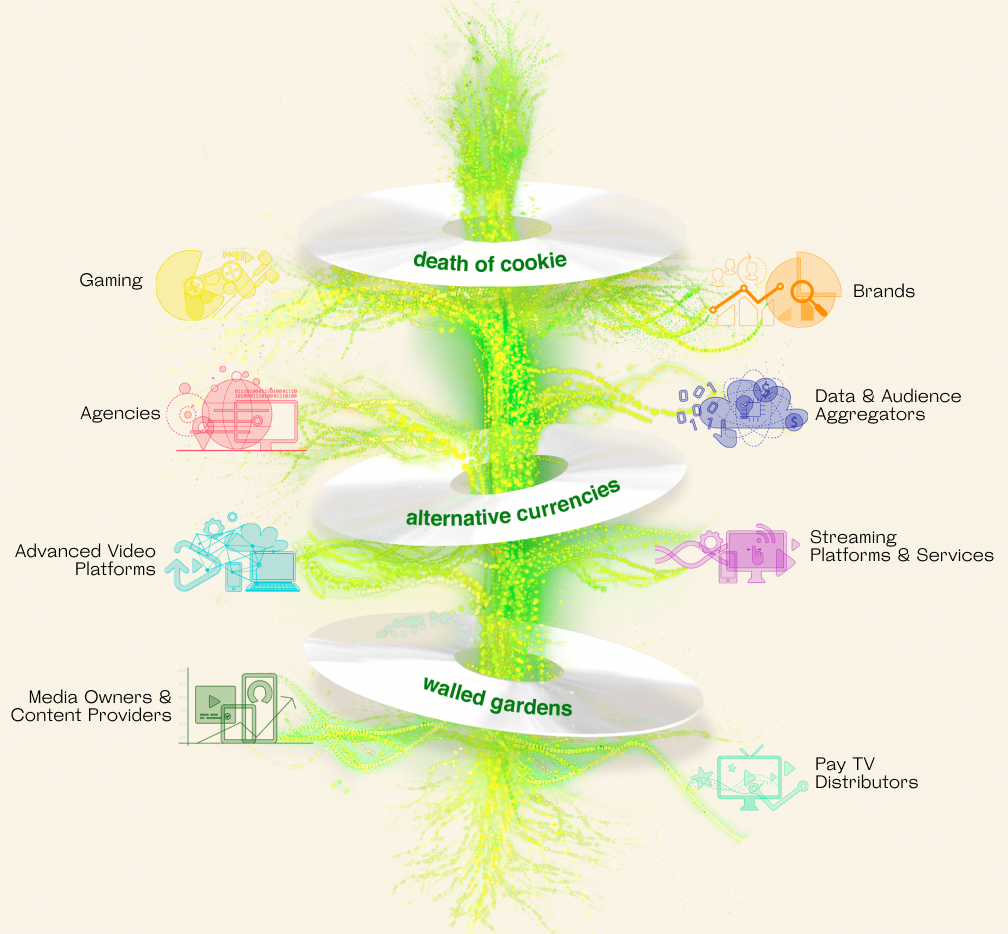
Centric Origin Data is the missing piece of today’s media puzzle. This never before available insight into the granular multidimensional behaviors of consumers provides the common language through which the entire media ecosystem can finally communicate.
The Way Forward
Despite the challenges it brings, this new media paradigm creates opportunities for the media industry to reach a renewed state of equilibrium. Without cookies, there will be room for new data standards that prioritize consumer privacy and security. Walled gardens have elevated conventions for data quality including greater control of impressions (albeit within a single platform). And new currencies have freed the industry from the shackles of a skewed monopoly.
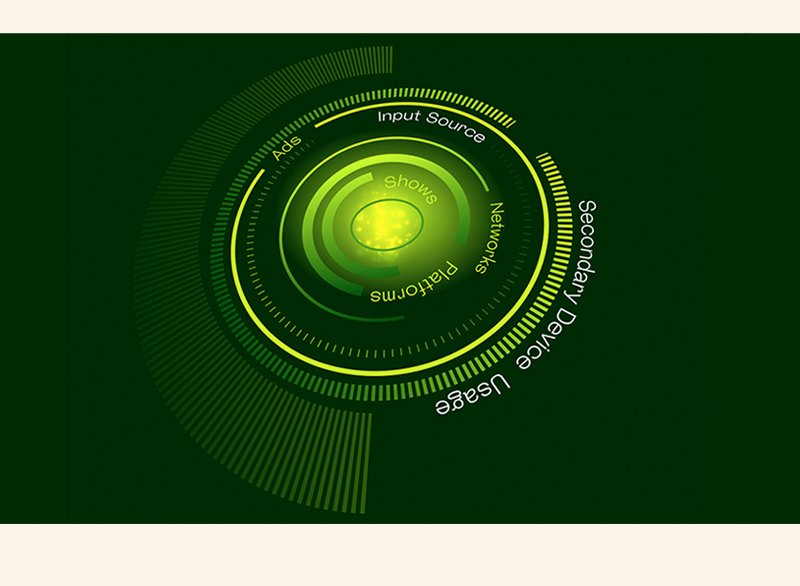
Hypha’s Centric Origin Data provides the missing link across the industry to bridge fragmentation in the face of these changing dynamis. This data serves as a matchkey, or a source of truth that calibrates and connects other large data sets together. It serves as a golden record to join disparate data sources and create a holistic reflection of human behaviors. The integration of this matchkey enables communication and collaboration between disparate datasets, future proofing the industry against the death of the cookie, the proliferation of walled gardens, and the emergence of a multi-currency trading landscape.
With demands for better measurement being heralded louder than ever before, the industry is coming together to create better solutions for today’s unique challenges. The missing link, a cross media matchkey, provides the crucial data layer necessary to finally bridge gaps across the entire media landscape and enable an interoperable future.
[1] http://welcome.openx.com/rs/745-BUQ-779/images/OX2020_OpenWeb_US_Final.pdf
[2] https://www.getpublica.com/blog/ctv-walled-gardens-rising-trends-the-state-of-ctv-targeting-2-2